


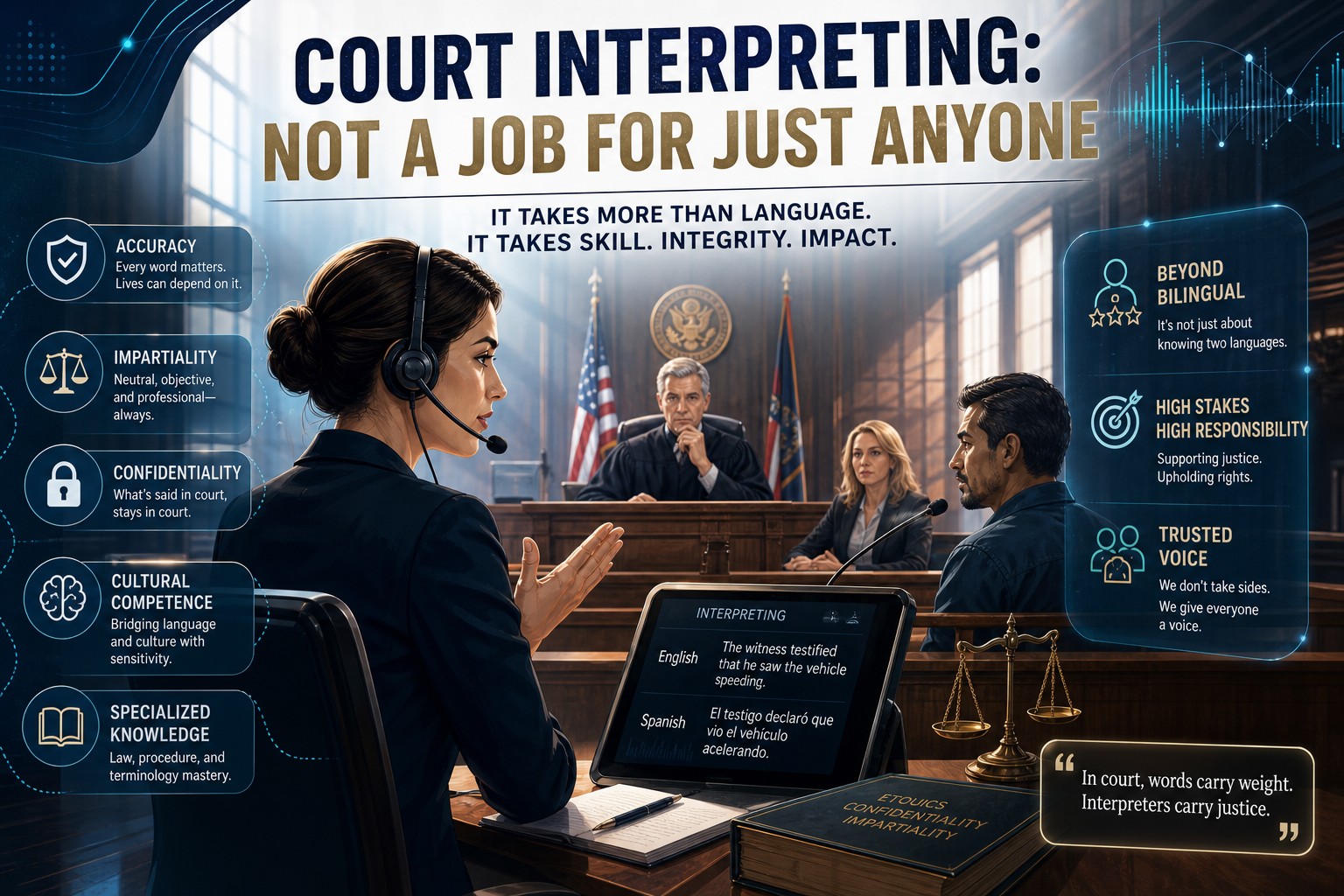
Court Interpreting: Not a Job for Just Anyone

Court Interpreting: Not a Job for Just Anyone
In the interpreting profession, many people assume that strong language skills alone are enough. However, when it comes to court interpreting, the role demands far more than fluency. A court interpreter plays a critical part in the justice system, directly impacting legal proceedings, the rights of individuals, and the accuracy of testimony.
A court interpreter does not simply convert words from one language to another. They must accurately convey legal meaning in its entirety. Courtroom language is highly specialized, involving terms related to testimonies, judgments, and legal procedures. Even a minor error in interpretation can affect the outcome of a case or lead to serious misunderstandings.
Beyond linguistic ability, court interpreters must have a solid understanding of legal systems, courtroom procedures, and professional conduct. They are required to remain neutral at all times, avoid expressing personal opinions, and strictly maintain confidentiality. The work is often performed in real time under high-pressure conditions, where precision and composure are essential.
One of the most important qualities of a court interpreter is impartiality. They must not take sides and must faithfully interpret every statement without adding, omitting, or altering the original message. This ensures that the court receives accurate and unbiased information.
For these reasons, court interpreting is not a role that just anyone can perform. It requires specialized knowledge, extensive experience, and a strong professional ethic.
If you are seeking professional interpreters for legal proceedings or other high-stakes environments, Onni Translation offers a carefully vetted team of experts ready to deliver accuracy, confidentiality, and professionalism in every situation.

